
What Are PPC Optimization Types?
PPC optimization types determine what your bidding algorithm is designed to maximize. Whether you optimize for revenue, profit, clicks, or viewable Cost per Mille, it directly impacts how ad budgets are allocated and which products receive more exposure.
Most sellers configure their optimization type once during setup and rarely revisit it. That’s a missed opportunity. The optimization type you choose defines what your bidding algorithm is built to maximize.
It defines whether your advertising campaigns prioritize growth, margin control, traffic generation, or visibility. Which directly controls where your budget flows and which products gain visibility.
Revenue Optimization
This is the most common optimization type used by Adspert users. It is how all Amazon Ads and eBay Ads PLA (Promoted Listings Advanced) campaigns are optimized, as well as the majority of Google Ads and Microsoft Ads campaigns with conversion tracking.
The main differentiator of Revenue Optimization is the conversion values that are automatically synced with the platforms. Those conversion values are Revenue, i.e. the price of the product per conversion. Revenue optimization type does not require any additional settings.
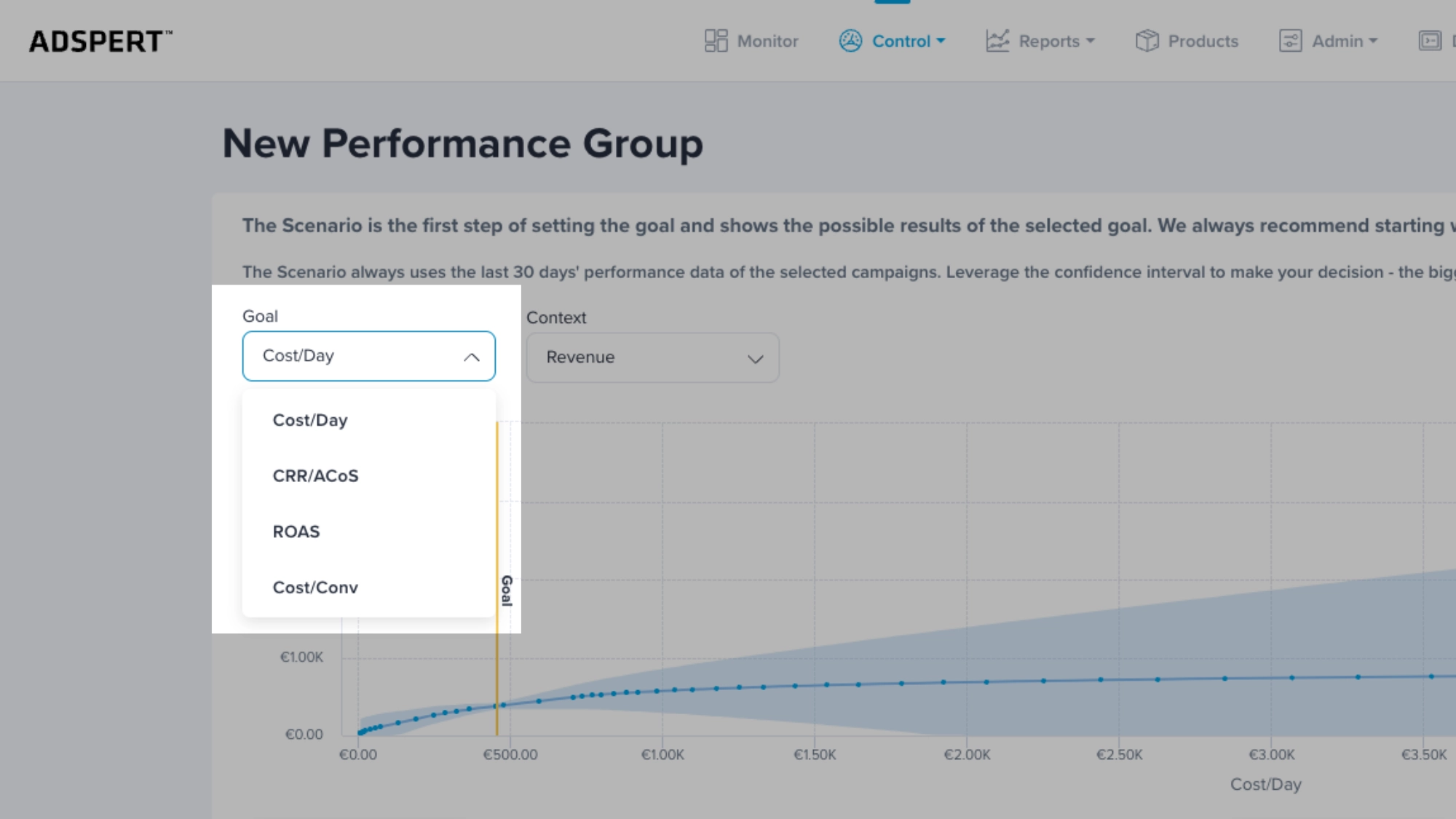
It is the default optimization type for all accounts with conversion tracking. Users can apply any of the following goals:
- Cost per Day
- Cost per Conversion
- ROI/ROAS
- ACoS/CRR
Profit Optimization
Profit Optimization is usually built on top of Revenue Optimization. The main difference with the other two PPC bidding optimization types is that the conversion value is the profit, i.e. product per conversion Revenue – Cost.
Profit Optimization is available for users with an Adspert Enterprise plan.
There are three ways to enable Profit Optimization:
- Providing a product feed to Adspert, so we can calculate the product gross and net profit considering the COGS (Cost of Goods Sold) from your product feed. It also takes into the account the platform fees, which are obtained automatically from the platform.
- In case of Google Ads and Microsoft Ads, where the conversion values can be defined manually, those can be inserted as gross profit. These campaigns then need to be marked as such on the Adspert side. Contact your Adspert representative for more information.
- Leveraging the Value of a conversion setting on the Settings page, where Revenue numbers can be converted into gross profit. However, that works on campaign level only, and not product – a limitation to keep in mind if working with eCommerce platforms.
Profit Optimization offers the following goals:
- Cost/Day
- Cost/Conversion
- ROI/ROAS
- Profit Maximization – only for Enterprise customers, as it requires detailed set up and account preparation.
Click Optimization
Click Optimization is used when there is no conversion value to begin with. If there is no conversion tracking, Adspert automatically switches to Click Optimization.
It applies to Google Ads and Microsoft Ads accounts with no conversion tracking, and has a more limited reporting, as well as goals:
- Cost per Day
- Cost per Click
vCPM Optimization (Viewable Cost per Mille)
vCPM (Viewable Cost per Mille) optimization is available in Adspert for Amazon Ads Sponsored Display and Sponsored Brands campaigns.
If you have at least one Sponsored Display or Sponsored Brands campaign, the vCPM optimization type will automatically appear when creating a new Performance Group.
Unlike Revenue or Profit optimization, vCPM focuses on impression-based bidding. It is designed for Sponsored Display campaigns that operate on a viewable CPM model.
How to Evaluate vCPM Optimization in Practice
Amazon Ads’ view-through attribution can significantly inflate reported performance. That’s why evaluation requires a structured approach.
Start with click-only data. As a general guide, if view-through conversions outnumber click-attributed conversions by more than 3–5 times, treat reported performance figures with caution.
Avoid relying purely on blended ACoS.
A drop in blended ACoS after launching vCPM may indicate impact or simply correlation with branded demand. Without isolation or a control window, conclusions remain uncertain.
Treat vCPM as assistive, not purely performance-driven.
How to Choose the Right PPC Optimization Type
Choosing the right PPC optimization type depends on your business objective, margin structure, and campaign setup. Each optimization type prioritizes a different outcome. Using the wrong one does not just affect performance metrics. It can shift budget toward the wrong products or goals.
Below is a practical framework to help you decide.
When Revenue Optimization Is the Right Choice
Revenue optimization is typically the right starting point for most advertisers.
It makes sense when:
- You are in a growth phase and prioritizing sales volume
- You are launching new ASINs and need momentum
- You are pushing ranking and visibility
- Your product margins are relatively consistent across the catalog
- Your profit data is incomplete or unstable
If margins across products are similar, optimizing for revenue is often close to optimizing for profit. In those cases, revenue serves as a reliable and simpler proxy.
Revenue optimization is also the safer choice when COGS (Cost of Goods Sold) data is not fully integrated or frequently changes.
When to Switch to Profit Optimization
Profit optimization becomes more powerful once your account matures and your data foundation is solid.
Consider switching when:
- You have reliable profit data
Profit optimization is only as accurate as your margin inputs. You need stable, product-level COGS (Cost of Goods Sold) integrated into Adspert. If margins fluctuate significantly or are incomplete, revenue may still be the safer option.
- Your margins vary significantly across products
As a rule of thumb, if margin variance across your catalog is significant (roughly 10–15% or more), Revenue Optimization can actively distort performance.
- You are past the aggressive growth phase
Revenue-first strategies help build visibility and rank. Once presence is established, profit optimization ensures you are not buying unprofitable sales.
- Your ACoS targets feel arbitrary
If you frequently adjust ACoS or ROAS targets based on instinct rather than margin math, it is often a sign that profit optimization would provide a more stable decision framework.
A practical rule of thumb:
If gross profit data is complete and stable, and margin variance across products exceeds 10–15%, Profit Optimization typically improves efficiency within a few weeks as the algorithm realigns bids to actual margin.
When Click Optimization Makes Sense
Click Optimization is appropriate when conversion tracking is unavailable, most commonly in Google Ads and Microsoft Ads accounts.
It can also work in early-stage campaigns where the goal is traffic volume or keyword data collection before profitability targets are set. Once conversion tracking is live and reliable, switching to Revenue or Profit Optimization will give the algorithm a stronger signal to work with.
When to Use vCPM Optimization
vCPM optimization, which stands for Viewable Cost per Mille, is available for Amazon Sponsored Display and Sponsored Brands campaigns that operate on impression-based bidding.
This optimization type is appropriate when visibility and audience reach are central to your strategy.
It makes sense when you are:
- Running upper-funnel campaigns
- Retargeting audiences who have already interacted with your brand or products
- Launching new products and warming audiences ahead of promotions
- Focusing on new-to-brand acquisition and need upper-funnel visibility before a launch or promotion
vCPM should not be evaluated purely through ACoS. It is best used when you understand that impression-based campaigns serve a different role within your overall advertising mix.
A Common Misconception About PPC Optimization Types
One of the most dangerous assumptions is that revenue growth automatically equals business growth.
Revenue numbers may look strong while low-margin ASINs absorb the majority of budget and profitability erodes behind the scenes.
Not all PPC optimization types serve the same business goal. Revenue maximizes volume. Profit protects margin. The two are not interchangeable.
Conclusion
PPC optimization types determine what your advertising algorithm prioritizes: revenue growth, margin protection, traffic acquisition or visibility.
- Revenue Optimization drives scale.
- Profit Optimization protects margin when data is reliable and product margins vary.
- Click Optimization supports accounts without conversion tracking.
- vCPM Optimization aligns Sponsored Display campaigns with impression-based bidding models.
The most effective PPC optimization type is the one aligned with your actual business objective and not simply the metric that looks best in a dashboard.